Cleantech Insights — September 2026
A couple of weeks ago, CrossBoundary Energy announced that it was bringing a first-of-its-kind 24/7 solar + storage project online to power a copper mine in the Congo. In India, Serentica Renewables recently announced that it was building a 1GWh solar+storage project to provide 24/7 power to commercial and industrial customers in Rajasthan.
These projects are not alone. In sunny places around the world, a growing number of independent power producers (IPPs) are already providing day/night, year-round renewable energy. In a recent report, the International Renewable Energy Agency (IRENA) highlighted solar+storage projects in the UAE and Saudi Arabia as well.
In high-irradiance markets such as Saudi Arabia, solar plus-storage configurations are approaching near- continuous availability at costs competitive with combined-cycle gas generation – broadly in line with the USD 70-80/MWh estimated for the Al Dhafra project in the United Arab Emirates – even where fossil fuels are domestically produced (BNEF, 2026a).
Relative to global demand, these projects are still small. But the fact that they exist at all is proof-of-concept for an argument that the think-tank Ember made last year: that batteries are now cheap enough for solar to provide electricity in every hour of every day in many of the sunniest parts of the world.
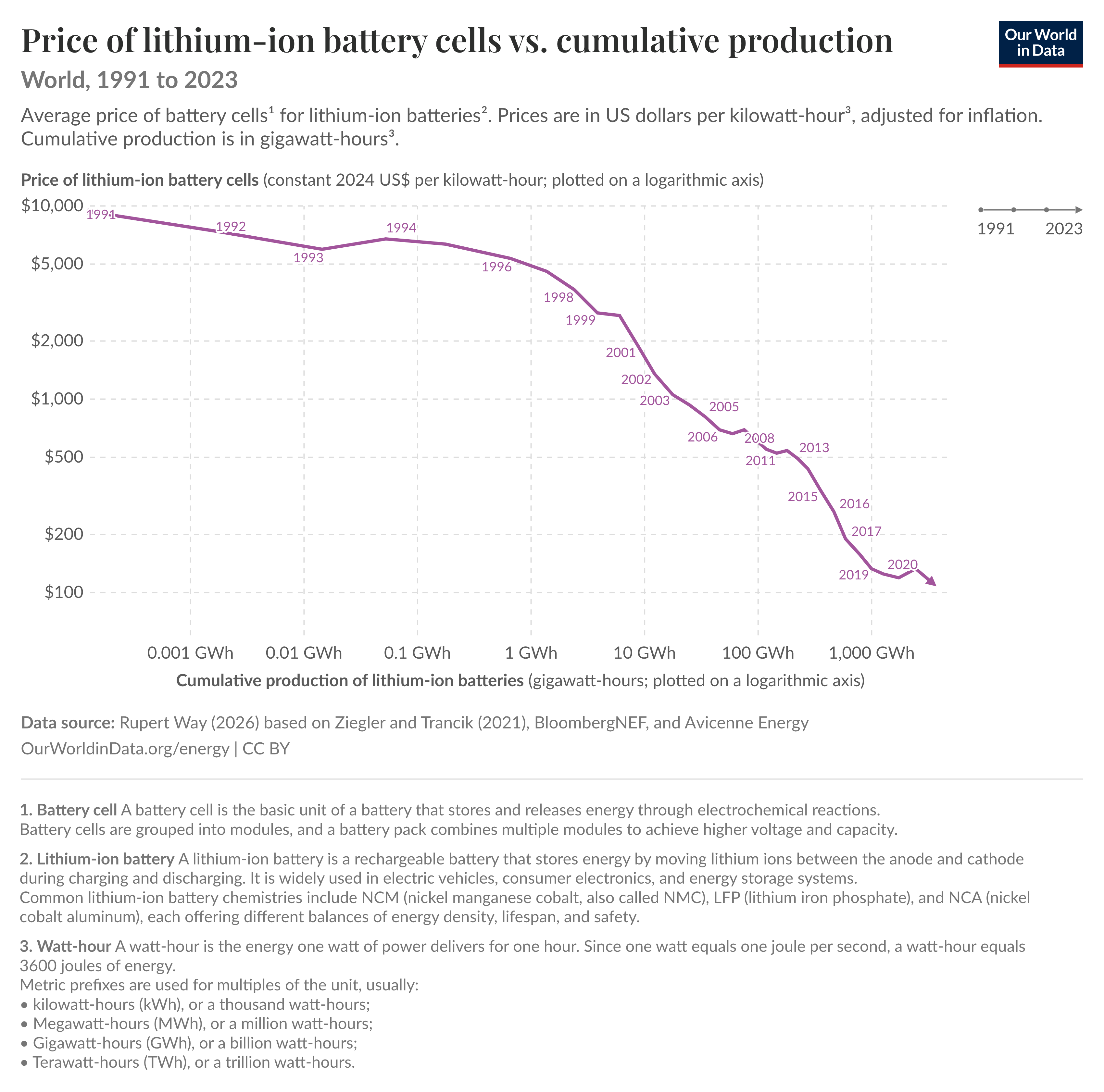
Ember’s analysis found six cities (Las Vegas, Mexico City, Johannesburg, Manila, Abuja, and Muscat) where solar + storage alone could meet more than 90 percent of annual demand. According to Ember, a place like Las Vegas doesn’t even need that much storage to meet 97% of its annual power needs.
What about the rest of us?
The problem, of course, is that not all of us are fortunate enough to live in cities as sunny as Las Vegas, Nevada, or Muscat, Oman — though you might be surprised at just how much power solar can produce, even in cloudy cities like Birmingham, England (62%).
Nevertheless, the challenge of closing the final intermittency gap isn’t trivial.
Spain, which has emerged as a poster child for the benefits of solar and wind power, illustrates the challenge. According to a recent Bloomberg article, over the last fifteen years, a huge buildout of renewables in the country has been a boon for consumers, who now pay substantially less for electricity than in peer countries. Power bills are actually lower now than they were before the invasion of Ukraine and the war in Iran.
At the same time, oversupply and difficulty installing enough storage—which the article blames on arcane permitting rules and “a lack of guidance from the EU on capacity markets”—has created a glut that has hurt investment, stressed the grid, and made life difficult for planners.
Can Long-term Storage Fill the Gap?
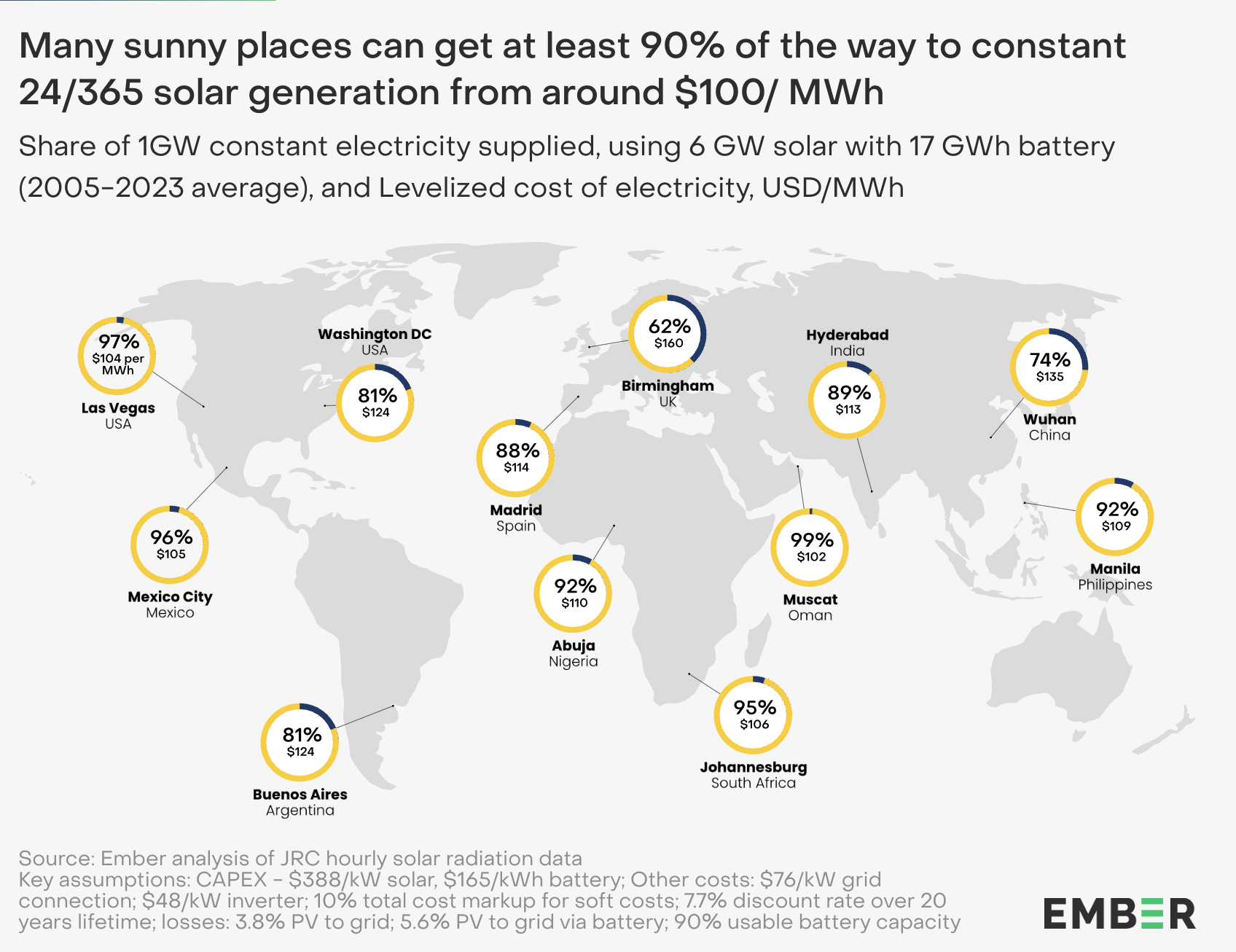
In sunny areas, the plummeting cost of solar panels and the almost-as-dramatic decline in the cost of lithium-ion batteries has made round-the-clock renewables power more cost-effective than ever. But to reach 24/7 renewable power across the globe, short-term battery storage isn’t enough. And while increasingly longer-duration storage is increasingly feasible, it’s still expensive—though exactly how expensive is difficult to pin down.
Unlike lithium-ion batteries, long-duration energy storage (LDES) refers to a wide range of technologies, including advanced batteries, compressed gas, pumped heat, and others. As an EPRI/LDES Council 2025 Benchmarking Report explained, data on LDES is limited, making it difficult to make apples-to-apples comparisons, especially when looking at the overall system benefit.
There is broad consensus, however, that prices for LDES are falling. Earlier this year, Google and Xcel Energy announced a partnership with Form Energy—a multi-day storage company that uses iron-air technology—to build “the largest battery project by gigawatt-hour energy capacity announced to date in the world” to support a data center in Minnesota “powered by 1.6 GW of renewable energy,” according to Utility Dive. This suggests that LDES has already become commercial, at least in some contexts.
Hybrid Systems FTW
In the meantime, solar and short-duration batteries cover a lot of ground, even if they don’t get us all the way to 100% everywhere. Adding wind closes the gap even more. Another Ember study pointed out that even in the cloudy U.K., only 2% of days in a typical year have both low wind and solar generation potential.
According to IRENA, most of the world’s population lives in high-irradiance, strong-wind zones. In these regions, hybrid renewables can cost-effectively meet 80-90% of demand, even without long-duration storage.
In other words, it is possible today, to meet the vast majority of the world’s electricity needs using wind, solar, and short-duration energy storage alone. The challenge of closing the final gap shouldn’t distract us from this fact.
Thanks for reading! Please forward this newsletter to anyone who might find it useful. As always, feel free to drop me a line. I’d love to hear your perspective on the challenges and opportunities of reaching 100% renewable energy in your corner of the world.
I work with innovators, climate activists, and policy professionals to tell stories that help drive the energy transition. Need help articulating complex energy and tech topics? Drop me a line.