Cleantech Insights — August 2026
Last year, I recapped the biggest cleantech stories of 2025 and those I was following in 2026.
In this week’s newsletter, I wanted to revisit some of those stories to see what’s changed—and what else we should be paying attention to.
Energy security is the new climate change
Last year, I suggested that energy security was the global sleeper story of energy transition in 2025. I think we can safely say this turned out to be true.
The ongoing war with Iran and the on-and-off closure of the Strait of Hormuz has disrupted nearly a fifth of the global oil and liquefied natural gas (LNG) trade. By many accounts, this disruption has accelerated the energy transition in countries around the world and strengthened China’s global dominance in cleantech.
The impacts of the war have been especially painful for Asian nations. In 2025, around 90% of LNG exported through the Strait was headed for the Asian market, which meant that the disruptions hit some of these nations especially hard.

Source: IEA
Half of Bangladesh’s electricity is generated from natural gas, a third of which comes from Qatar. The country has responded to shortages by closing universities and instituting rolling blackouts. Load shedding has devastated the textile industry, the country’s most important economic sector, with energy shortages causing a 20% drop in industrial output.
The Philippines, which imports 98% of its oil from the Middle East, declared a national emergency almost as soon as the war started as both gasoline and electricity prices skyrocketed. Since then, the crisis has caused widespread political unrest including street protests and nationwide strikes by transit workers.
Indonesia, Sri Lanka, Cambodia, and South Korea all instituted some form of fuel rationing, including shortened work-weeks and license-plate-based driving restrictions.
All of this has put immense pressure on countries and individuals across the entire region to increase their energy independence.
Countries like Pakistan found that the impact of energy shortages was blunted by the recent boom in rooftop solar and storage. According to the Center for Research on Energy and Clean Air (CREA), Pakistan’s previous solar buildout has helped the country avoid load shedding and saved billions in oil and gas imports.
China, meanwhile, appears to have largely absorbed the oil shock. In recent years, China has invested heavily in renewable energy and the electrification of transit—more than half of all automobiles purchased there in 2025 were EVs or plug-in electrics. This shift allowed the country to build significant petroleum reserves that it is now drawing on to reduce the impact of reduced imports. At the same time, it has positioned itself as the world’s largest developer and exporter of clean energy technology—especially solar and EVs.
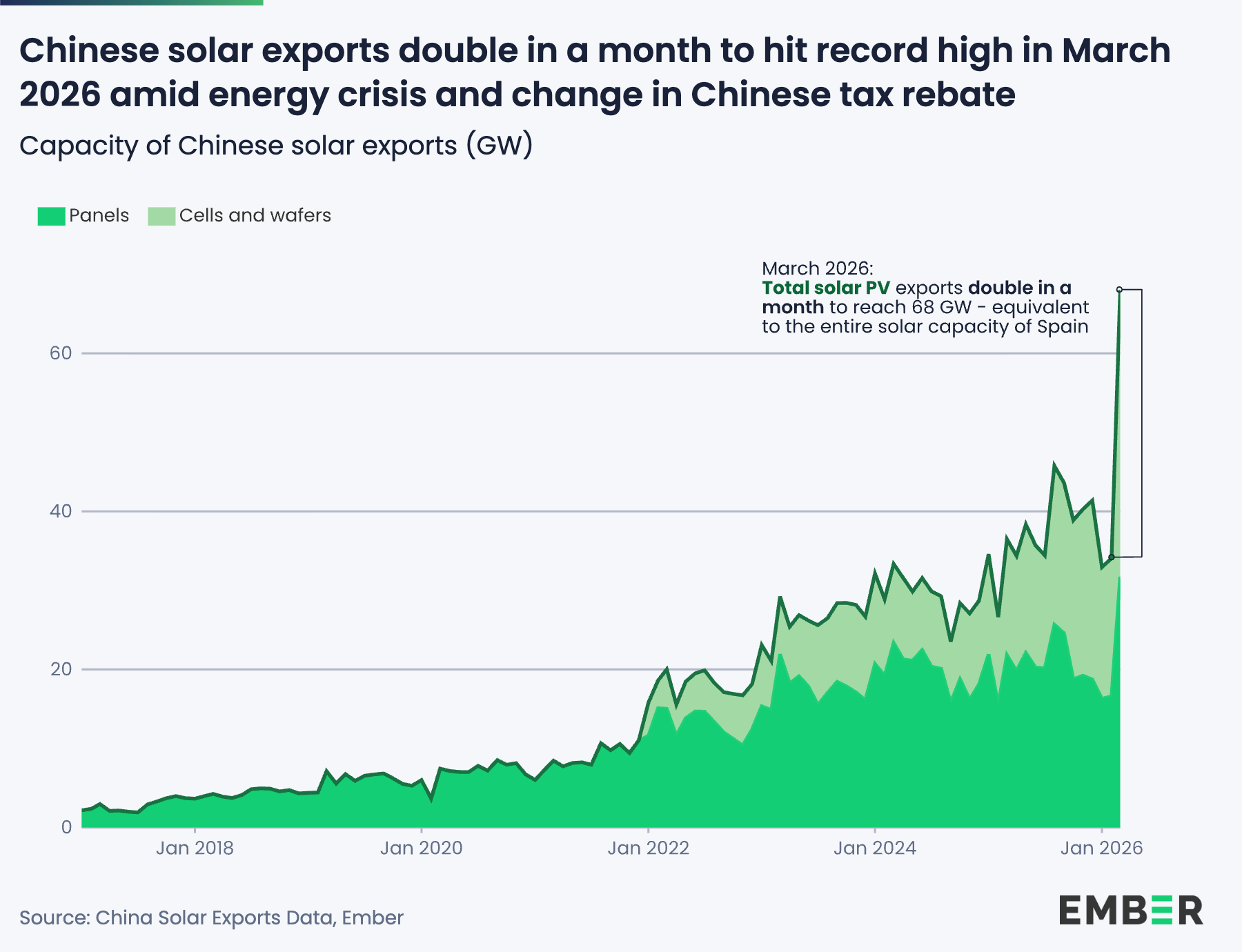
According to clean energy think-tank Ember, in March, China’s solar panel exports doubled to 68 GW, equivalent to Spain’s entire solar capacity. Fifty countries imported an all-time record number of solar panels from China. Battery exports also surged.
In 2025, the Chinese car manufacturer BYD overtook Tesla as the largest global manufacturer of electric vehicles. In 2026, China’s EV exports have surged 120%. The country’s overall domestic car market has weakened this year, but the decline was steeper for conventional cars than for EVs.
Meanwhile, the disruption to international LNG markets has dealt the industry a blow it may not recover from, as Justin Mikulka and others have extensively reported. According to Ember, looking only at upfront costs, building solar is now competitive with fossil fuel generation—before you take into account the cost of fuel. Solar plus storage will follow by 2030.
Critics will no doubt say that gas generation is still more reliable—but that’s a hard argument to make when a fifth of natural gas supply can disappear overnight.
In short, the pain the Iran war has caused in energy markets has only served to accelerate the clean energy transition around the world. Unless fossil fuel resources suddenly become much cheaper and the global market becomes less risky, this trend is likely to continue.
Data center wars and utility backlash
In the first half of 2026, big tech’s massive data center buildout continued—and citizen pushback was fierce.
From a clean energy and affordability perspective, the biggest question was how utilities would meet the massive loads these companies brought to the grid.
Some experts have pointed out that data centers could, in theory, both reduce energy costs for consumers by widening the rate base and accelerate the energy transition by paying to add renewable capacity.
In practice, lowering costs by widening the rate base has mostly worked in states like North Dakota that already have excess capacity and whose infrastructure costs were concentrated on maintenance, not expansion.
On the other hand, growth in data centers has driven double-digit increases in retail electricity rates in large markets like PJM (the Pennsylvania-New Jersey-Maryland interconnection).
Forward-thinking experts like Jigar Shah have argued that the best way to meet data center load growth is to “squeeze more value out of the system” with distributed energy resources (DERs) and virtual power plants—especially community-scale solar and storage projects. According to Shah, by targeting specific substations and feeders that need relief, front-of-the-meter storage projects can actually reduce costs and the need for larger-scale transmission upgrades.
McGee Young of WattCarbon has proposed a complementary approach in which large energy users (including data centers) procure demand flexibility by paying for load-shifting measures in their community (PPAs for VPPs). For example, a large-load data center could pay to install load-shifting heat pumps and improve insulation across a neighboring community—reducing customer costs, building goodwill, and ensuring that they themselves have enough power to run their servers.
While there has been movement on innovative proposals like these, many data center builders have chosen to go a different way. Frustrated by the slow pace of utility interconnection, companies like Meta and xAI have instead begun frantically building their own “behind-the-meter” natural gas power plants to meet their overwhelming hunger for compute.
Just last year, it seemed unlikely that natural gas would be able to feed the data center beast in the near term; manufacturers of traditional combined-cycle gas turbines were reporting back orders stretching into the 2030s.
Undaunted, data center developers have come up with creative alternatives, using mobile gas generators and repurposing and refurbishing turbines from jet engines and industrial operations. These generators are dirtier and much less efficient than a combined-cycle power plant.
According to a report from Cleanview CEO Michael Thomas, data center developers have built the equivalent of two nuclear plants’ worth of capacity in the past year and a half. Thomas’ research has identified an additional 59 planned behind-the-meter data centers which would use a staggering 90 GW of capacity in the next few years.
At the same time, data center developers have faced an intense wave of opposition from local communities. Citizens across the country blame data centers for higher utility bills, and are upset about their massive footprints.
Data Center Watch, a research firm that tracks opposition to data center development, reports that local opposition has blocked or delayed more than $64 billion in data center development between 2023 and March of 2025, with an additional $98 billion blocked or delayed from March to June of the same year.
Public approval of data centers has fallen precipitously, with some polls showing that seven in ten Americans now oppose constructing data centers in their local area, and nearly half are strongly opposed. In contrast, only 7% are strongly in favor.
This lack of support comes at a time of growing skepticism of AI in general, even as businesses struggle to make it work for the bottom line. It’s becoming increasingly difficult to see how AI companies will ever pay back their massive debts.
Growing public hostility toward AI and data centers is also inextricable from hostility toward electric utilities, especially IOUs. The narrative that utilities are raising rates on average citizens to support data centers while raking in record profits has already caused political earthquakes throughout the country.
All of this suggests that whatever the trajectory is now, there’s a good chance that much of the projected buildout of data centers and associated energy consumption will not materialize as planned.
New Technology: The Big Bets
For years, advocates of the clean energy transition have dreamed that geothermal energy could play a greater role in shifting our system away from fossil fuels. Unlike wind and solar, heat from under the Earth’s surface offers the promise of an always-on resource.
But while geothermal energy has been around for a long time, it’s only been viable in places with volcanic activity or where the Earth’s crust is thin. Iceland, for instance, uses geothermal energy to meet 90% of its heating and 30% of its electricity demand, and geothermal generates nearly half of Kenya’s electricity. Overall, however, geothermal energy currently meets less than 1% of global energy demand.
With recent advances in drilling, however, companies like Fervo Energy are hoping to change that. Fervo believes that they can tap a much larger geothermal resource using techniques borrowed from the oil and gas industry.
Excitement over the technology—including from a number of big players in the AI data center space—recently allowed Fervo to raise $1.89 billion in the largest clean energy IPO in history.
Part of the appeal was, no doubt, that unlike solar and wind, geothermal energy hasn’t drawn the ire of the current administration and thus isn’t as tied to culture-war narratives.
A few skeptics, however, have wondered if the technology might be overhyped. As Justin Mikulka points out, the company is positioning itself as an alternative to “firm” resources like nuclear and gas, which are expensive and have long timelines. On the other hand, based on their own financials, even in the best case scenario Fervo’s power will be more expensive than solar + storage.
According to Mikulka, Fervo’s defense—that advanced geothermal has a much higher capacity factor than solar+storage (83% vs 17-23%)—dramatically understates solar’s actual capacity factor.
At the moment, Fervo’s stock price is trading below its IPO price. Time will tell if it emerges as a revolutionary force that transforms geothermal power and the global energy system, or remains a niche player.
Fusion Dreams
For decades, fusion has been a just-around-the-corner technology, but it does seem like it may be on the verge of commercialization.
Just last week, Commonwealth Fusion Systems (CFS) raised $1 billion to support completion of its Massachusetts demonstration reactor by 2027 and construction of the first commercial fusion power plant in Virginia, which is scheduled to go online by the early 2030s. Google and ENI have signed power purchase agreements to buy more than half the power it produces. CFS has submitted an interconnection request to PJM; if approved, fusion will deliver actual power to the grid for the first time.
Altogether, the fusion industry raised nearly $4.5 billion in the last year, according to the Fusion Industry Association.
Advocates of fusion say it has many advantages over fission nuclear reactors, including virtually limitless fuel, no possibility of a meltdown, limited risk of proliferation, and no long-lived radioactive waste.
Critics, however, point to the widely varying projections of how much fusion will cost. With no commercial reactors yet built, it’s not easy to predict how expensive fusion electricity will eventually be.
Fusion companies argue that once the first commercial reactors come on line, the industry will learn by doing and costs will fall rapidly. A recent study in Nature Energy, however, suggested that the industry’s projections on how fast costs will come down “are without any robust rationale and overestimated.” As a result, they argue, it’s unlikely to become cost competitive.
As with advanced geothermal, fusion solves the intermittency problem of solar and wind. What’s unclear is if it does so cost-effectively compared to other renewable-firming solutions like long-duration storage.
Small-Scale innovations with big impacts
On the opposite end of the spectrum is the growth of smaller-scale companies that are solving decarbonization challenges with innovative thinking and clever design.
I’m thinking of companies like Copper, which has integrated batteries into induction stoves to reduce the need for electric panel upgrades, and Gradient, which has designed a heat pump that can fit almost anywhere you’d put a window air conditioner—plugging into a massive untapped market in multi-unit housing.
Aggregators like David Energy and Every Electric are using small batteries in creative ways to take advantage of demand response programs and time-of-use rates to shift load in homes and businesses.
Portable solar panels that can be plugged into a standard wall outlet are taking off. These panels don’t require complicated installation or regulatory approvals and can be put almost anywhere there’s sun, which makes them especially useful for renters and apartment dwellers. A recent study in Renewable Energy found that with updated regulations, plug-in solar could save Americans $13 billion a year. According to the World Resources Institute, almost half of U.S. states are considering legislation that would remove regulatory barriers to the technology.
All of these solutions are examples of small-scale, nimble innovations that, taken together, could have significant impact on the energy transition.
Many paths forward
The big story last year was the death of the IRA and the administration’s overall hostility toward renewables. This year, we’re seeing that in spite of opposition, the case for clean energy and electrification has only gotten stronger, especially outside the United States. Concerns about affordability and energy security are not going away.
Even as some investors continue to make big bets on new, high-capital approaches to large-scale generation, I believe most of the action will continue to be in wind, solar, storage, and the electrification of buildings and transportation, with each of these presenting diverse challenges in different settings that will be addressed with a myriad of different policy and technical solutions at different scales. It will be interesting to see how all of this evolves as we head into 2027.
Thanks for reading! Are there any big stories I’m missing? I’d love to hear what you think—drop me a line, or connect with me on LinkedIn.
To get these updates in your inbox, sign up here. See you next time.